Pengurusan Harta Luqatah Digital: Analisis Prosedur dan Pembinaan Model dalam Konteks Institusi Agama di Malaysia
Digital Luqatah Property Management: Procedural Analysis and Model Development in the Context of Religious Institutions in Malaysia
DOI:
https://doi.org/10.55265/al-maqasid.v6i1.458Keywords:
Pengurusan Luqatah, Harta Digital, Perlindungan Data, Penyelarasan Prosedur, Institusi Agama, Luqatah Management, Digital Property, Data Protection, Procedural Standardization, Malaysian Religious InstitutionsAbstract
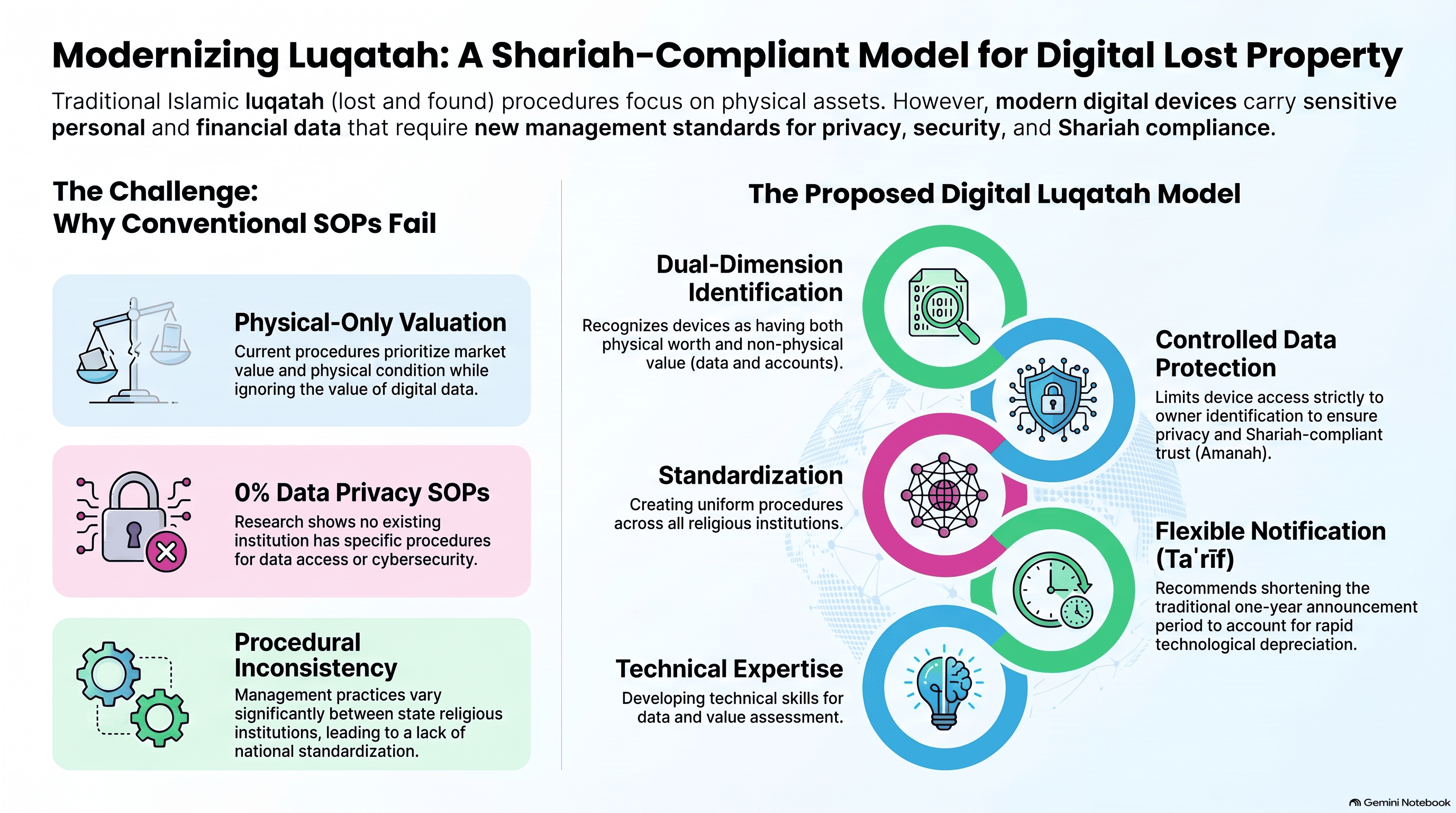
The rapid proliferation of smartphones, laptops, tablets, smartwatches, and other digital devices has introduced new challenges for the management of luqatah (lost-and-found property), particularly because such devices possess both physical value and digital content that may contain sensitive personal, financial, professional, and confidential information. Existing luqatah management practices, however, have largely been developed for conventional physical property and may not adequately address issues relating to data privacy, cybersecurity, ownership verification, and unauthorised access. This study aims to analyze the management of luqatah property involving digital devices and to evaluate the suitability of existing procedures in the current context. The study adopts a qualitative approach through interviews with institutions involved in the management of luqatah property. The findings indicate that current management procedures remain focused on physical property and do not fully take into account the characteristics of digital devices that contain data and personal information. In addition, there are variations in the implementation of procedures across institutions, which affect the consistency of management practices. Accordingly, this study proposes a digital luqatah management model that includes the identification of digital property, data protection, procedural standardization, adjustment of public notification periods, and the development of technological expertise. This model supports a more systematic approach to property management that is aligned with contemporary developments. The study contributes to the contemporary discourse on luqatah by extending its application beyond conventional physical property and provides practical guidance for policymakers and institutions in developing standardised operating procedures for the secure, transparent, and Shariah-compliant management of lost digital devices.Downloads
References
Abd Hamid, M. F. (2024). Pengurusan harta luqatah di Malaysia: Perbahasan fiqh dan praktikal. Retrieved from https://www.researchgate.net/publication/384294766_Pengurusan_Harta_Luqatah_di_Malaysia_Perbahasan_Fiqh_dan_Praktikal
Abd Wahab, N. (2024). Islamic inheritance of digital assets. Retrieved from https://journal.inceif.edu.my/index.php/ijif/article/download/713/483/2524
Abdullah, M. R., et al. (2025). An analysis of procedures and management of Muslim property at Baitulmal. Retrieved from https://www.researchgate.net/publication/390161432_AN_ANALYSIS_OF_PROCEDURES_AND_MANAGEMENT_OF_MUSLIM_PROPERTY_AT_BAITULMAL
Al-Kāsānī, ʿA. (1986). Badā’iʿ al-Ṣanā’iʿ fī Tartīb al-Sharā’iʿ. Beirut: Dār al-Kutub al-ʿIlmiyyah. https://waqfeya.net/book.php?bid=118
Al-Nawāwī, Y. (1972). Al-Majmūʿ sharḥ al-Muhadhdhab. Beirut: Dār al-Fikr.
Al-Ramlī, S. (1984). Nihāyah al-Muḥtāj ilā Sharḥ al-Minhāj. Beirut: Dār al-Fikr.
Al-Zuḥaylī, W. (1985). Al-Fiqh al-Islāmī wa Adillatuhu. Damsyik: Dār al-Fikr.
Apriyani, D. (2025). Luqatah in fiqh muamalah. Retrieved from https://ejournal.seaninstitute.or.id/index.php/JMS/article/download/6112/4765
Auda, J. (2008). Maqasid Al-Shariah as Philosophy of Islamic Law: A Systems Approach. London: IIIT. https://iiit.org/wp-content/uploads/Maqasid-Al-Shariah-as-Philosophy-of-Islamic-Law.pdf
Ayub, M. (2007). Understanding Islamic Finance. Wiley. https://onlinelibrary.wiley.com/doi/book/10.1002/9780470754498
Aziz, A., & Abdullah, N. (2020). Digital assets in Islamic finance. Retrieved from https://www.researchgate.net/publication/340000000
Hasan, R., & Salah, O. (2021). Digital assets and Shariah compliance. Retrieved from https://www.researchgate.net/publication/350000000
Ibn Ḥajar al-Haytamī, A. (2016). Tuḥfah al-Muḥtāj bi Sharḥ al-Minhāj. Beirut: Dār al-Kutub al-ʿIlmiyyah.
Ibn Qudāmah, A. (1997). Al-Mughnī. Cairo: Dār al-Ḥadīth. https://archive.org/details/almughni
Ismail, M., & Rahim, A. (2024). Digital assets from Islamic perspective (2019–2024): A review. Retrieved from https://irep.iium.edu.my/121351/7/121351_Digital%20assets%20from%20Islamic%20perspective%20%282019-2024%29.pdf
Islamic Wealth Management: Theory and Practice. (2017). Retrieved from https://dokumen.pub/islamic-wealth-management-theory-and-practice-1nbsped-9781786439390-9781786439383.html
Kahf, M. (2003). The role of waqf in improving the ummah welfare. Retrieved from https://monzer.kahf.com/papers/english/role_of_waqf_in_improving_the_ummah_welfare.pdf
Md Tahir, S. N., et al. (2025). Digital assets from an Islamic jurisprudential perspective. Retrieved from https://jmm.uis.edu.my/index.php/jurnal/article/view/214
Muṣtafā al-Khin, M., al-Bughā, M., & al-Sharbajī, ʿAlī. (1992). Al-fiqh al-manhajī ʿalā madhhab al-Imām al-Shāfiʿī. Damsyik: Dār al-Qalam.
OECD. (2021). Digital transformation and the future of work. Retrieved from https://www.oecd.org/digital/
Pratama, D. (2025). Digital asset inheritance in Islamic law. Retrieved from https://e-journal.metrouniv.ac.id/istinbath/article/view/11224
The Understanding of Ruling and Management of Luqatah (Lost Property). (n.d.). Retrieved from https://mjsl.usim.edu.my/index.php/jurnalmjsl/article/download/195/202/1578
World Bank. (2022). Digital development overview. Retrieved from https://www.worldbank.org/en/topic/digitaldevelopment
Downloads
Published
How to Cite
Issue
Section
License
Copyright (c) 2025 Radin Ahmad Taufik Salikin Izaddin, Ahmad Syukran Baharuddin, Wan Abdul Fattah Wan Ismail, Lukman Abdul Mutalib, Hasnizam Hashim, Zulfaqar Mamat, Mohammad Amir Wan Harun, Muhammad Aunurrochim Mas'ad Saleh

This work is licensed under a Creative Commons Attribution-NonCommercial 4.0 International License.