Penggunaan Aplikasi Temu Janji di Malaysia: Analisis Syariah, Etika Digital dan Implikasi Sosial terhadap Masyarakat Malaysia
The Use of Dating Applications in Malaysia: A Shariah, Digital Ethics, and Social Implications Analysis on Malaysian Society
DOI:
https://doi.org/10.55265/al-maqasid.v6i1.377Keywords:
Dating apps, Maqasid Syariah, Ethics, Islamic LawAbstract
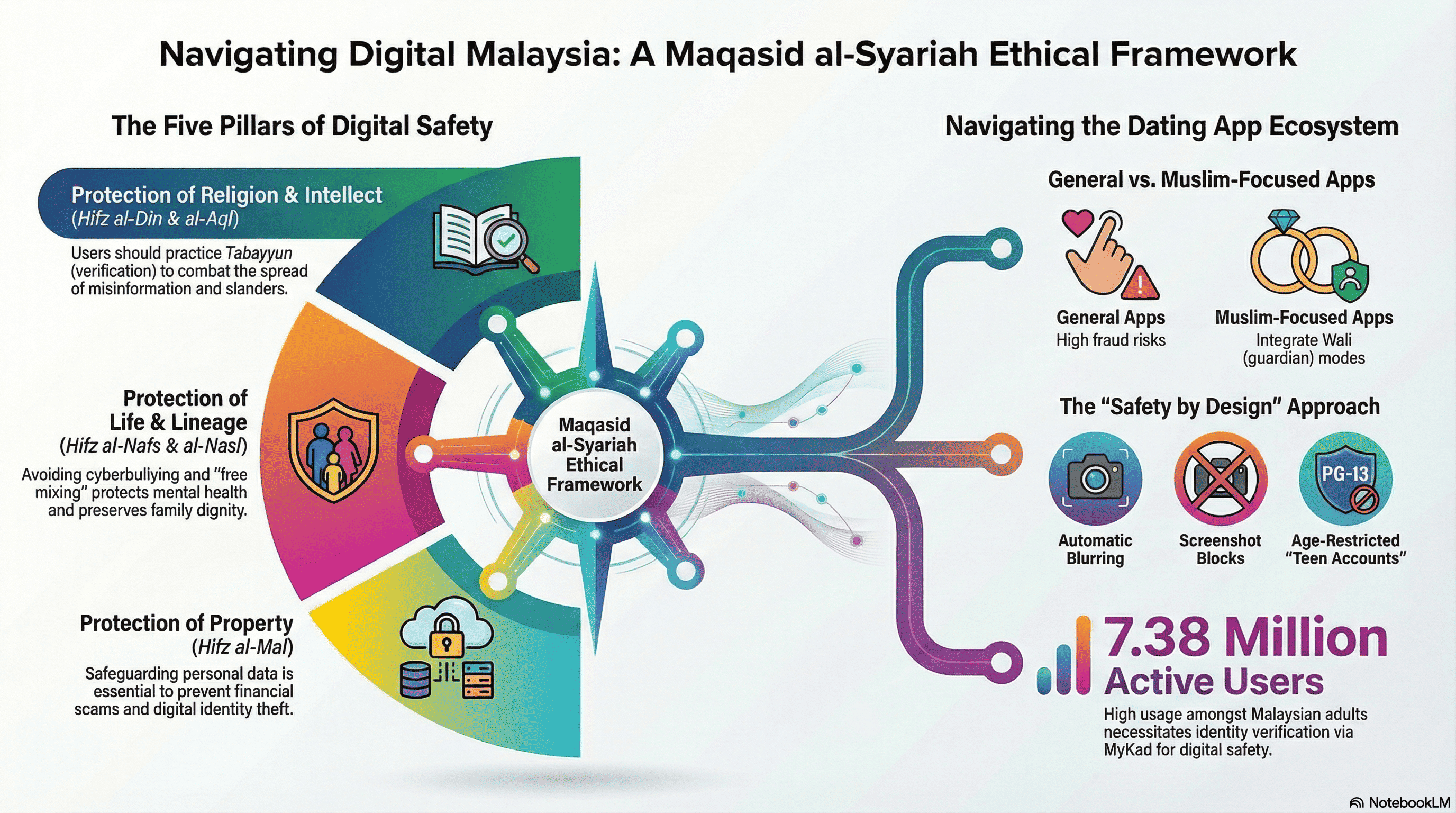
This study examines the role of dating applications as a modern medium of social interaction within Malaysian society. It assesses the degree to which their use aligns with digital ethics, cultural norms, and the principles of Shariah. Using a qualitative approach that includes socio-digital literature analysis and comparative review of different application types, the study outlines the distinctions between general dating apps, Muslim-oriented platforms, and community-specific applications, including their modes of interaction, intended purposes, and behavioural risks. The findings suggest that general applications often foster casual connections that can lead to unregulated social interactions. In contrast, Muslim-focused applications prioritise safety, privacy, and Shariah-compliant procedures. Applications that contradict Malaysian law, on the other hand, raise concerns regarding identity exposure, exploitation, and behaviours that conflict with societal values. The study recommends the development of usage guidelines grounded in the objectives of Shariah, including mechanisms for digital literacy that emphasise privacy, safety, and the preservation of users’ dignity, particularly for adolescents and vulnerable groups. Additionally, stronger ethical education and content monitoring are necessary to reduce opportunities for manipulation and misuse. In conclusion, aligning the growth of dating application technology with Shariah principles and Malaysian cultural norms has the potential to produce a digital social ecosystem that is more balanced, safe, and respectful of societal values.
Abstrak
Kajian ini meneliti peranan aplikasi temu janji sebagai medium interaksi sosial moden dalam kalangan masyarakat Malaysia serta menilai sejauh mana penggunaannya selaras dengan etika digital, norma budaya dan prinsip Syariah. Melalui pendekatan kualitatif yang merangkumi analisis literatur sosio-digital dan perbandingan jenis aplikasi, kajian ini menghimpunkan perbezaan antara aplikasi umum, aplikasi berorientasikan Muslim dan aplikasi khusus komuniti, termasuk bentuk interaksi, tujuan penggunaan serta risiko tingkah laku. Hasil kajian mendapati bahawa aplikasi umum lebih cenderung kepada hubungan santai yang membuka ruang kepada pergaulan bebas, manakala aplikasi Muslim menekankan keselamatan, privasi dan kesesuaian Syariah. Aplikasi yang bercanggah dengan undang-undang Malaysia pula menimbulkan isu pendedahan identiti, eksploitasi dan tingkah laku yang bertentangan dengan nilai masyarakat. Kajian ini mencadangkan agar garis panduan penggunaan aplikasi temu janji disusun berasaskan Maqasid Syariah, termasuk mekanisme literasi digital yang memberi penekanan kepada privasi, keselamatan dan penjagaan maruah pengguna, khususnya remaja dan golongan berisiko. Di samping itu, pendidikan etika interaksi atas talian serta pemantauan kandungan wajar diperkukuh bagi mengurangkan ruang manipulasi dan salah guna. Kesimpulannya, penyelarasan antara perkembangan teknologi temu janji dengan prinsip Syariah dan norma Malaysia berpotensi mewujudkan ekosistem sosial digital yang lebih seimbang, selamat dan menghormati nilai masyarakat.Downloads
References
Ahdini, A., Duri, C., & Pratiwi, S. (2023). Perspektif Islam Terhadap Aplikasi Kencan: Menyeimbangkan Teknologi Modern Dengan Nilai Budaya. Bayani, 3(2), 99-112. https://doi.org/10.52496/bayaniv.3i.2pp99-112
Bandinelli, C., & Gandini, A. (2022). Dating Apps: The Uncertainty of Marketised Love. Cultural Sociology, 16, 423–441. https://doi.org/10.1177/17499755211051559
Batri, N. M., Mohd Yusof, F., Muhamad, S. N., Hassan, A. M., Ripin, M. N., & Haron, Z. (2016). Homoseksual: Antara Hukum dan Kemajuan Sains. Sains Humanika, 8(4). https://doi.org/10.11113/sh.v8n4.1033
Castro, Á., & Barrada, J. (2020). Dating Apps and Their Sociodemographic and Psychosocial Correlates: A Systematic Review. International Journal of Environmental Research and Public Health, 17(18), 6500. https://doi.org/10.3390/ijerph17186500
Deuraseh, N. (2008). Protection Against STDs: An Islamic Criminal Law Approach. Arab Law Quarterly, 22, 88–108. https://doi.org/10.1163/026805508x286785
Dwivedi, Y., Ismagilova, E., Hughes, D., Carlson, J., Filieri, R., Jacobson, J., Jain, V., Karjaluoto, H., Kefi, H., Krishen, A., Kumar, V., Rahman, M., Raman, R., Rauschnabel, P., Rowley, J., Salo, J., Tran, G., & Wang, Y. (2020). Setting the future of digital and social media marketing research: Perspectives and research propositions. International Journal of Information Management, 59, 102168. https://doi.org/10.1016/j.ijinfomgt.2020.102168
Hassan, W., & Adom, L. (2022). Sadd al-Dhara'i' in crime prevention. IJARBSS. https://doi.org/10.6007/ijarbss/v12-i4/13084
Hoang, N. P., Asano, Y., & Yoshikawa, M. (2016, January). Your neighbors are my spies: Location and other privacy concerns in dating apps. In 2016 18th International Conference on Advanced Communication Technology (ICACT) (pp. 715-721). IEEE.
Hobbs, M., Owen, S., & Gerber, L. (2017). Liquid love? Dating apps, sex, relationships and the digital transformation of intimacy. Journal of Sociology, 53, 271–284. https://doi.org/10.1177/1440783316662718
Huang, Y., & Gong, A. (2025). Too vulnerable to resist: Problematic use of dating apps associated with social appearance anxiety, social interaction anxiety, and rejection sensitivity. Computers in Human Behavior, 165, 108566. https://doi.org/10.1016/j.chb.2025.108566
Ibrahim, A. H., Rahman, N. N. A., Saifuddeen, S. M., & Baharuddin, M. (2019). Maqasid al-Shariah based Islamic bioethics: A comprehensive approach. Journal of bioethical inquiry, 16(3), 333-345. https://doi.org/10.1007/s11673-019-09902-8
Isa, A. S. B. Md., Yusoff, K. B., & Hamzah, H. B. (2021). Maqasid Syariah & spiritual control in social media use. Journal of Fatwa Management and Research, 26(2), 323–333. https://doi.org/10.33102/jfatwa.vol26no2.418
Ismail, A. M, Subri, I. M., Baharuddin, A. S., Ab. Rahman, A. & Rosidi, M. H. (2024). The Role of Maqasid Al-Shariah in Contemporary Fatwa Formulation: A Balanced Approach. Al-Qanatir International Journal of Islamic Studies, 33(7), 1-28.
Kamaruzaman, N. A. F., Abdulah, N. A., Mutalib, M. A., Hazram, N. A., & Sukari, A. (2024). Penguatkuasaan Jenayah Syariah Terhadap Lesbian, Gay, Biseksual dan Transgender (LGBT) Dalam Talian Di Malaysia: Analisis Tinjauan Literatur Sistematik: The Enforcement of Islamic Criminal Offences Related to Lesbian, Gay, Bisexual and Transgender (LGBT) LGBT Online in Malaysia: A Systematic Literature Review Analysis. Journal of Muwafaqat, 7(2), 56-68. https://doi.org/10.53840/muwafaqat.v7i2.182
Kross, E. et al. (2020). Social media and well-being. Trends in Cognitive Sciences, 25, 55–66. https://doi.org/10.1016/j.tics.2020.10.005
Megat Danuwa, M. M., Mohamad Dom, M. H. H., Ahmad Fuad A. A. Z. & Rosidi, M. H. (2025). Assessing the legality of heterosexual marriage among LGBT individuals: An analysis from the perspective of Maqasid al-Shariah. International Journal of Research and Innovation in Social Science, IX(VII), 1797–1809.
Mohd Azam, M. D. I., Ahmad, M. I. A., & Rosidi, M. H. (2025). The disclosure of a spouse’s disgrace before and after divorce: A Maqasid al-Shariah-based legal analysis of the ‘spill the tea’ and ‘exposing ex’ phenomenon. International Journal of Research and Innovation in Social Science, 9(6), 5200–5206.
Nurdin, R. (2021). False Identity dalam Online Dating Tinder. JEHSS, 3, 1011–1022. https://doi.org/10.34007/jehss.v3i3.493
Phan, A., Seigfried, K., & Choo, K.-K. R. (2021). Dating app risks. Computers in Human Behavior Reports, 3, 100055. https://doi.org/10.1016/j.chbr.2021.100055
Pym, T., Byron, P., & Albury, K. (2020). Queer community on dating apps. International Journal of Cultural Studies, 24, 398–413. https://doi.org/10.1177/1367877920959332
Rosidi, M. H. (2024). Facilitating Access to Art and Pre-exposure Prophylaxis for LGBTQ Individuals in Combating HIV in Malaysia: An Analysis from a Shariah Perspective. International Journal of Research and Innovation in Social Science (IJRISS), VIII(VIII), 4191-4202.
Rosidi, M. H., Ismail, A. M., & Mokhtar, A. W. (2025). Analisis Pelaksanaan ART Dan PrEP Dalam Membendung HIV: Perspektif Syariah: Analysing the Implementation of ART and PrEP in Combatting HIV: A Shariah Perspective. Journal of Fatwa Management and Research, 30(1), 174–198.
Rosidi, M. H., Mokhtar, A. W., & Abdul Majid, M. N. (2021). The Impact Of Social Media On The Acceptance Of Fatwas Among Malaysian Muslims. Journal of Fatwa Management and Research, 26(1), 17–36.
Rosidi, M. H., Mokhtar, A. W., & Abdul Majid, M. N. (2022). Penggunaan Media Dalam Talian Menurut Perspektif Maqāṣid Al-Shari‘ah. Journal of Fatwa Management and Research, 27(3), 78–105.
Rosidi, M. H., Mokhtar, A. W., & Abdul Majid, M. N. (2022). The Role of Maqasid Al-Shari’ah as a Fundamental Ethics in Social Media Use. International Journal of Academic Research in Business and Social Sciences, 12(4), 1285-1301.
Rosli, F. S., Zahari, N. N., Faizolakhman, N. I., & Rosidi, M. H. (2025). The influence of social media on marital conflict: An analytical study through the lens of Maqasid Al-Shariah in preserving family stability and dignity. International Journal of Research and Innovation in Social Science, 9(7), 598–608.
Short, J., Williams, E., & Christie, B. (1976). The Social Psychology of Telecommunications. John Wiley & Sons.
Sinar Harian. (2024, Jun 28). Padah sudah kahwin, gila aplikasi cinta.
Sinar Harian. (2025, Mac 20). Penuntut IPTS samun, pukul kenalan aplikasi janji temu.
Sumter, S., & Vandenbosch, L. (2018). Dating gone mobile: Demographic and personality-based correlates of using smartphone-based dating applications among emerging adults. New Media & Society, 21, 655–673. https://doi.org/10.1177/1461444818804773
Whitty, M., & Buchanan, T. (2016). Romance scam psychological impact. Criminology & Criminal Justice, 16(2). https://doi.org/10.1177/1748895815603773
Wu, S., & Trottier, D. (2022). Dating apps: a literature review. Sociology Compass, 16(2). https://doi.org/10.1111/soc4.12951
Downloads
Published
How to Cite
Issue
Section
License
Copyright (c) 2025 Muhammad Syamil Faizi Fakhrorrazi, Ahmad Fathi Naim Najmi Ismail, Muhammad Idham Rosli, Muhammad Badrul Amin Mohd Ridzuan

This work is licensed under a Creative Commons Attribution-NonCommercial 4.0 International License.