- JOURNAL POLICIES
- Aims and Scope
- Peer Review Process
- Publication Ethics and Misconduct
- Allegations of Research Misconduct
- Retraction and Correction
- Withdrawal of Manuscript
- Plagiarism Policy
- Copyright and Licensing
- Publication Frequency
- Revenue Sources & APC
- Open Access Policy
- Archiving Policy
- Generative AI Policies
- Abstracting and Indexing
Peer Review Process
Overview
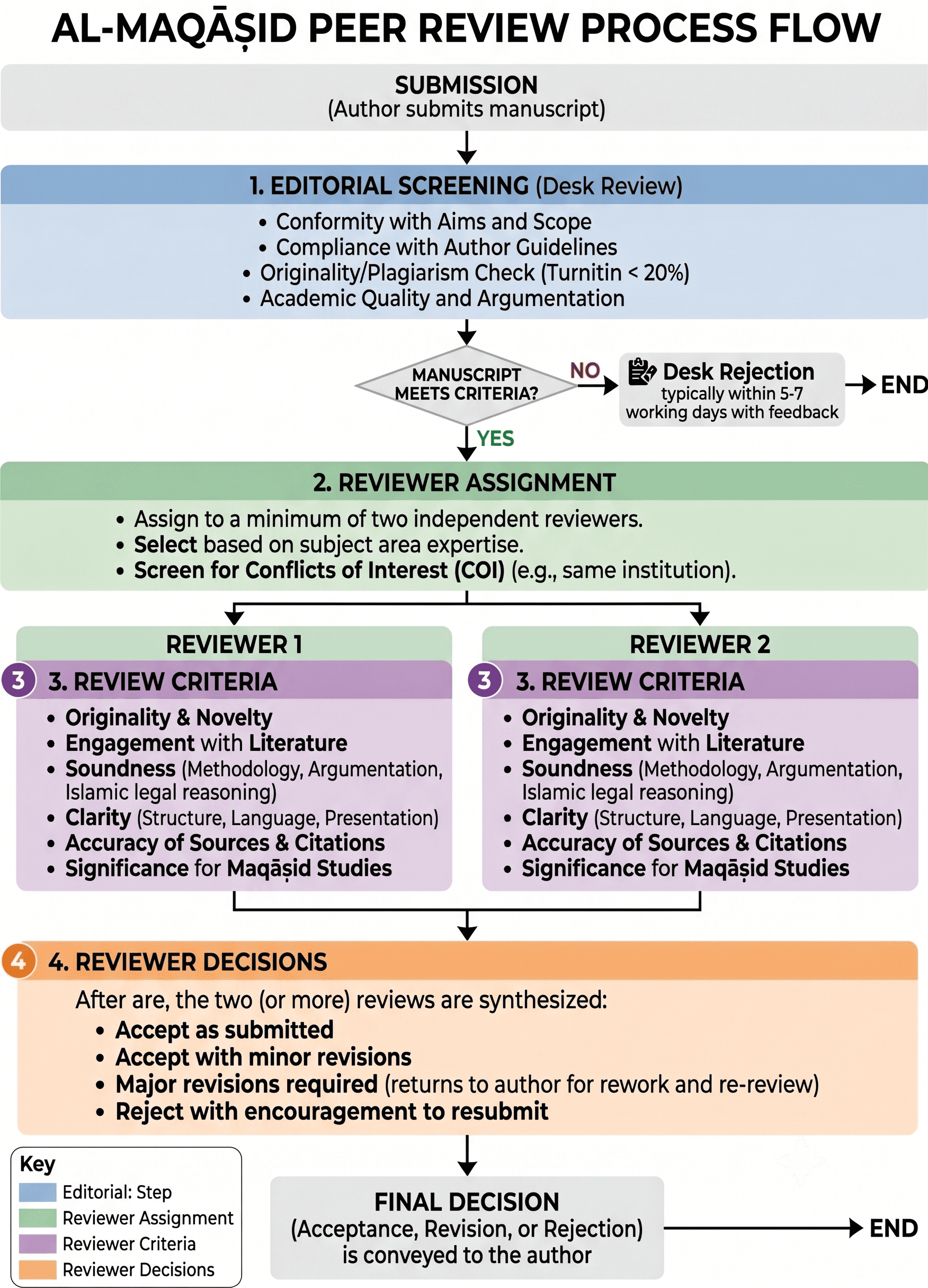
AL-MAQĀṢID operates a rigorous double-blind peer review process. In double-blind review, the identities of authors are concealed from reviewers, and the identities of reviewers are concealed from authors throughout the entire review process. This model is adopted to ensure impartiality, fairness, and the integrity of scholarly evaluation.
Editorial Screening
Upon submission, every manuscript undergoes an initial desk review by the Managing Editor, who assesses:
- Conformity with the journal's aims and scope
- Compliance with formatting and submission requirements as outlined in the Author Guidelines
- Originality and absence of plagiarism, verified using Turnitin or equivalent software (similarity threshold: ≤20% overall, with no single source exceeding 5%)
- Minimum standards of academic quality, argumentation, and scholarly presentation
Manuscripts that fail to meet these minimum criteria are returned to authors at the desk rejection stage, typically within 5–7 working days, with brief editorial feedback.
Reviewer Assignment
Manuscripts that pass desk review are assigned to a minimum of two independent reviewers with recognised expertise in the relevant subject area. Reviewers are selected from a global pool of subject specialists and are screened for conflicts of interest. Reviewers affiliated with the same institution as any author of a submission will not be assigned to that submission.
Review Criteria
Reviewers are asked to evaluate manuscripts on the following dimensions:
- Originality and novelty of the scholarly contribution
- Adequacy of engagement with existing literature
- Soundness of argumentation, methodology, and Islamic legal reasoning
- Clarity of structure, language, and academic presentation
- Accuracy and appropriateness of sources and citations
- Significance of the topic for the field of maqāṣid studies and Islamic research
Reviewer Decisions
Reviewers submit one of the following recommendations:
- Accept as submitted
- Accept with minor revisions
- Major revisions required (manuscript returned for substantial revision and re-review)
- Reject with encouragement to resubmit after major reworking
- Reject outright
Timeline
The journal targets the following processing timeline:
- Initial desk decision: 5–7 working days
- First peer review decision: 6–10 weeks from submission
- Revised manuscript review: 3–6 weeks
- Final decision: communicated promptly upon completion of review
Note: Timelines are targets and may vary depending on reviewer availability and manuscript complexity. Authors will be kept informed of any significant delays.
Revision Process
Authors required to revise their manuscript will receive consolidated reviewer comments and a revision deadline (typically 4–8 weeks). Authors must submit a point-by-point Response to Reviewers document alongside the revised manuscript, addressing each comment explicitly. Revised manuscripts may be returned to the original reviewers at the Editor-in-Chief's discretion.
Confidentiality
All manuscripts under review are treated as strictly confidential. Reviewers must not disclose manuscript content to any third party, discuss submissions with colleagues, or use unpublished information from a manuscript for their own purposes without the explicit written permission of the corresponding author. This obligation persists after a review decision has been made.
Reviewer Conflicts of Interest
Reviewers who identify a conflict of interest after accepting a review assignment must notify the editorial office immediately and recuse themselves. Conflicts include, but are not limited to, co-authorship with any manuscript author within the past five years, direct supervisory or competitive relationships, and financial interests related to the work.